


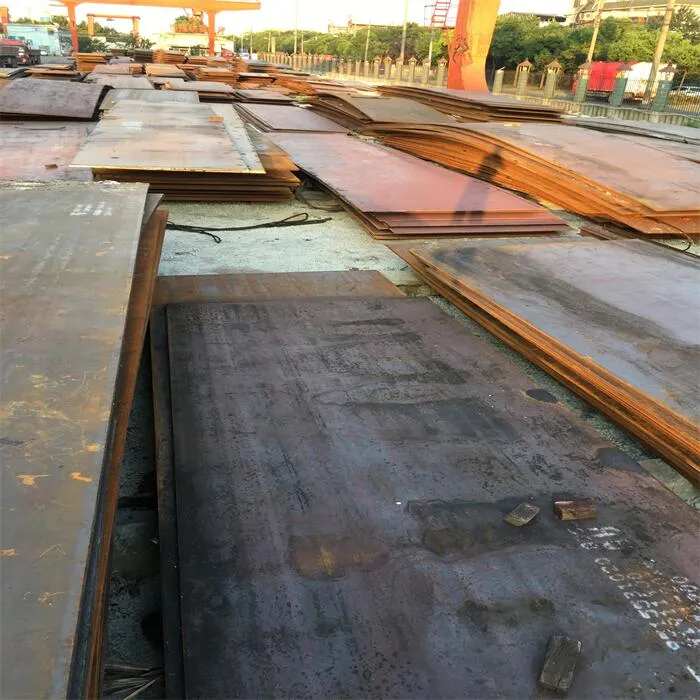
AB/DQ43 Steel Plate
Products Description Influence of Alloy Additives on the Temperature Rise of Molten Steel During the steelmaking process, various alloy additives are often added to improve the properties of steel. Taking the addition of nickel (Ni) as an example, the specific heat of nickel is approximately...
Description
Products Description
Influence of Alloy Additives on the Temperature Rise of Molten Steel
During the steelmaking process, various alloy additives are often added to improve the properties of steel. Taking the addition of nickel (Ni) as an example, the specific heat of nickel is approximately 0.44 kJ/(kg·°C). When nickel alloy additives are added to the molten steel, during the heating stage, nickel will absorb a large amount of heat for its own temperature increase. Suppose in a small electric furnace steelmaking process, the mass of the molten steel is 1000 kg, the initial temperature is 1400 °C, and 100 kg of nickel alloy is added. If the heating power is 100 kW (that is, 100 kJ of heat is provided per second), according to the heat calculation formula (, where is the heat, is the mass, is the specific heat, and is the temperature change), without considering other heat losses and other components in the molten steel, for the nickel alloy, . By calculation, the temperature increase of the nickel alloy is approximately . While under the same amount of heat, the temperature increase of the molten steel (assuming the specific heat of the main component iron in the molten steel is about 0.46 kJ/(kg·°C)) is approximately . It can be seen that the temperature of the nickel alloy rises faster relative to the main body of the molten steel after absorbing heat, which will slow down the temperature rise rate of the main body of the molten steel, resulting in an extension of the time for the molten steel to reach the target temperature in the entire steelmaking process, thus affecting the production efficiency.
Influence of the Mixture of Different Scrap Steels on the Melting Time
When the recycled scrap steel contains different components, the difference in specific heat will have a significant impact on the melting process. For example, for the mixed scrap steel containing aluminum (Al) and iron (Fe). The specific heat of aluminum is approximately 0.90 kJ/(kg·°C), and that of iron is about 0.46 kJ/(kg·°C). Suppose there is a pile of mixed scrap steel, in which the mass percentage of aluminum is 30% and that of iron is 70%, with a total mass of 500 kg. During the converter steelmaking process, heating is carried out by top - blown oxygen. When the heating flame provides a certain amount of heat, due to the large specific heat of aluminum, in the early stage of heating, the temperature of aluminum rises slowly after absorbing heat. While the temperature of iron rises relatively fast and begins to melt. However, as iron melts, part of the heat it absorbs is used for its own state change (from solid to liquid), and the other part is transferred to the surrounding unmelted aluminum. Because aluminum heats up slowly and requires more heat to reach its melting point, in this case, the melting time of the entire scrap steel will be longer than that of single iron scrap steel. This is due to the specific heat characteristics of aluminum, which lead to changes in the distribution and utilization of heat in the scrap steel and affect the melting efficiency.
ABS DQ43 Marine steel chemical composition in shipbuilding steel plate, angle steel bar, bulb flat bar, L section steel bar
|
Grade |
C max |
Si |
Mn max |
P max |
S max |
Als |
N max |
Nb max |
V max |
Ti max |
B max |
|
DQ43 |
0.21 |
0.10-0.55 |
1.7 |
0.035 |
0.035 |
0.015-0.08 |
0.20 |
0.02-0.05 |
0.04-0.10 |
0.02 |
0.005 |


Influence of the Specific Heat of Raw Materials on the Temperature Gradient in the Furnace
In large converter steelmaking, multiple raw materials exist simultaneously in the furnace. If the specific heat differences among the raw materials are large, obvious temperature gradients will be formed. For example, there are a large number of high - specific - heat alloy raw materials (such as copper alloys, the specific heat of copper is approximately 0.39 kJ/(kg·°C)) and ordinary scrap steel in the furnace. During the blowing process, heat will be preferentially absorbed by the high - specific - heat alloy raw materials, making the temperature in the surrounding areas relatively low. This will lead to the occurrence of relatively large local temperature differences in the furnace, affecting the uniform transfer of heat in the furnace. For example, near the furnace wall, the temperature may be relatively low due to the melting of scrap steel and the heat absorption of alloy raw materials, while in the area directly heated by the flame in the center of the furnace, the temperature is relatively high. This temperature gradient will complicate the heat transfer process in the furnace, which is not conducive to the stable progress of the steelmaking process, because the uneven temperature may lead to uneven melting of raw materials, and then affect the quality of steel.
Why Choose Us?
We take pride in our ability to provide custom solutions for our customers' unique needs.
We analyze and compare the previous products and the current technical situation of our AB/DQ43 Steel Plate, and develop new technical specifications and processes.
Our customers trust us to deliver high-quality Cold-rolled Steel products on time and on budget.
We strictly implement the warm and thoughtful after-sales service, adhere to the development of good professional ethics.
We offer a wide range of Cold-rolled Steel products to meet diverse customer needs.
We adhere to the customer-centric and brand-oriented business philosophy, and continue to provide customers with reliable and excellent products and services.
Our factory is committed to upholding the highest standards of safety and quality.
All staff of our company and all departments work together to combine business management, professional technology, quantitative statistical methods and ideological education.
Our Cold-rolled Steel products are known for their durability and reliability.
Relying on the superior conditions and strong advantages of mass production, we are able to meet the different needs of our customers.
Hot Tags: ab/dq43 steel plate, China ab/dq43 steel plate suppliers, factory, S890QL, S235J0, S31703, C61000, CuZn36Pb1 5, N06601


