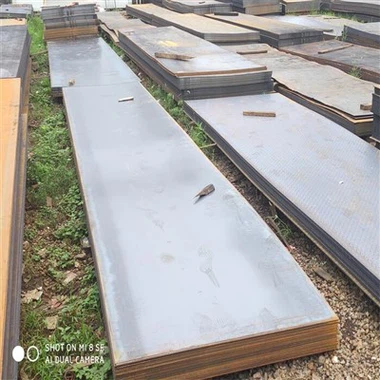
High Quality Abrasion Wear Resistant Composite Steel Plate
Products Description Key Properties Exceptional Wear Resistance : The surface layer's hard carbides resist abrasion from particles (e.g., sand, gravel, ore) and sliding friction, extending service life by 3–10 times compared to 普通 carbon steel or mild steel. Strong Bonding : The two layers...
Description
Products Description
Key Properties
Exceptional Wear Resistance: The surface layer's hard carbides resist abrasion from particles (e.g., sand, gravel, ore) and sliding friction, extending service life by 3–10 times compared to 普通 carbon steel or mild steel.
Strong Bonding: The two layers are metallurgically bonded (via welding or explosion cladding), with bonding strength ≥200 MPa-preventing delamination even under intense impact or thermal stress.
Balanced Toughness: The ductile base layer absorbs impact energy, avoiding brittle fracture (a common issue with single-layer high-hardness steels), making the plate suitable for dynamic wear scenarios (e.g., crusher liners, excavator buckets).
Workability: Unlike fully hardened wear-resistant steels (which are difficult to weld or cut), the base layer allows standard fabrication processes: cutting (plasma, oxy-fuel), welding (MIG, TIG), drilling, and bending.


Manufacturing Processes
The quality of the composite bond and wear layer depends on the manufacturing method. Common techniques include:
Overlay Welding (Cladding):
The most widely used method, where the wear-resistant alloy (e.g., high-chromium cast iron, ferrochrome) is deposited onto the base steel via submerged arc welding (SAW) or open-arc overlay welding.
Advantages: Thick wear layers (up to 20mm), uniform hardness distribution, cost-effective for large plates.
Applications: Large-scale components (e.g., mine truck beds, conveyor troughs).
Explosive Cladding:
High-energy explosion bonds the wear-resistant layer (e.g., high-chrome steel, stainless steel) to the base layer under extreme pressure.
Advantages: Ultra-strong metallurgical bond, thin wear layers (0.5–5mm), suitable for complex shapes.
Applications: Precision parts (e.g., hydraulic cylinder liners, pump impellers).
Roll Bonding:
Hot rolling presses the two layers together at high temperature, forming a mechanical-chemical bond.
Advantages: Ideal for thin plates, consistent thickness, high production efficiency.
Why Choose Us?
We take pride in our ability to provide custom solutions for our customers' unique needs.
We analyze and compare the previous products and the current technical situation of our High Quality Abrasion Wear Resistant Composite Steel Plate, and develop new technical specifications and processes.
Our customers trust us to deliver high-quality Cold-rolled Steel products on time and on budget.
We strictly implement the warm and thoughtful after-sales service, adhere to the development of good professional ethics.
We offer a wide range of Cold-rolled Steel products to meet diverse customer needs.
We adhere to the customer-centric and brand-oriented business philosophy, and continue to provide customers with reliable and excellent products and services.
Our factory is committed to upholding the highest standards of safety and quality.
All staff of our company and all departments work together to combine business management, professional technology, quantitative statistical methods and ideological education.
Our Cold-rolled Steel products are known for their durability and reliability.
Relying on the superior conditions and strong advantages of mass production, we are able to meet the different needs of our customers.
Hot Tags: high quality abrasion wear resistant composite steel plate, China high quality abrasion wear resistant composite steel plate suppliers, factory, 2 4617, 2 4642, Inconel625, Inconel690, N06601, N10001