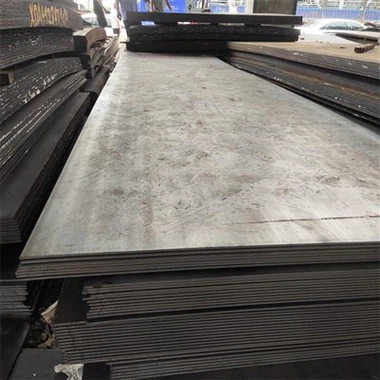
CCS F460 Steel Plate
Products Description Mechanical Property Testing Tensile Test Purpose and Principle : Tensile test is a fundamental method for evaluating the mechanical properties of steel plates after normalizing. Its purpose is to determine the stress-strain relationship of the steel plate under tensile...
Description
Products Description
Mechanical Property Testing
Tensile Test
Purpose and Principle: Tensile test is a fundamental method for evaluating the mechanical properties of steel plates after normalizing. Its purpose is to determine the stress-strain relationship of the steel plate under tensile loading, so as to obtain key mechanical property indicators. An axial tensile force is applied to the steel plate specimen by a tensile testing machine, causing the specimen to gradually elongate until it fractures. During this process, the testing machine records the data of the tensile force and elongation, and then calculates the yield strength, tensile strength, and elongation.
Importance and Interpretation of Indicators: Yield strength is the stress at which the material begins to undergo significant plastic deformation, reflecting the ability of the steel plate to resist initial plastic deformation. For example, in some structural applications, if the yield strength is insufficient, the structure will undergo irreversible deformation when subjected to a relatively small load. Tensile strength represents the maximum stress that the material can withstand during the tensile process, reflecting the ultimate ability of the steel plate to resist fracture. Elongation is an important indicator for measuring the toughness of the material. The higher the elongation, the greater the deformation that the material can withstand before fracture, indicating better toughness.
Hardness Testing
Testing Methods and Principles: Commonly used hardness testing methods include Rockwell hardness (HRC, HRB, etc.) and Brinell hardness (HB) testing. In Rockwell hardness testing, a diamond cone or a hardened steel ball indenter is pressed into the material surface with a certain pressure, and the hardness value is determined according to the indentation depth. In Brinell hardness testing, a cemented carbide ball indenter with a certain diameter is pressed into the material surface under a specified test force, and the hardness is calculated by measuring the indentation diameter.
Association with the Effect of Normalizing: The change in hardness of the steel plate after normalizing can reflect the changes in its internal microstructure. Generally, normalizing can refine grains, eliminate internal stresses, etc., and these changes will lead to changes in hardness. If the hardness is within a reasonable range after normalizing, it indicates that the normalizing process has achieved the expected effect on the adjustment of the microstructure. For example, if the hardness is moderate after normalizing, it may mean that a good balance between the strength and toughness of the steel plate has been achieved.
Impact Toughness Testing
Testing Conditions and Procedures: Impact toughness testing mainly adopts the Charpy impact test, including the Charpy V-notch impact test and the Charpy U-notch impact test. The steel plate specimen with a notch is placed on the support of the impact testing machine, and then the specimen is impacted by a pendulum, causing the specimen to fracture instantaneously under the impact load. The impact testing machine records the energy difference before and after the pendulum impacts the specimen, and this energy difference is the impact absorption energy, which is used to measure the impact toughness of the material.
Significance in Practical Applications: In practical applications, steel plates may be subjected to sudden impact loads, such as collisions in the field of mechanical engineering and impacts on building structures in the event of earthquakes. Good impact toughness can ensure that the steel plate will not break easily under these circumstances, thereby ensuring the safety and reliability of the structure.
Microstructure Evaluation
Metallographic Microscope Observation
Observation Contents and Methods: The microstructure of the steel plate after normalizing is observed by a metallographic microscope, mainly focusing on the size, shape, and distribution of grains. The steel plate specimen undergoes a series of metallographic sample preparation steps, including cutting, mounting, grinding, polishing, and etching, and then is placed under the metallographic microscope for observation.
Relationship between Microstructure Characteristics and Properties: Fine and uniform grains usually indicate that the material has better properties. Fine grains can effectively impede the propagation of cracks and improve the strength and toughness of the material. For example, if the grains are observed to be equiaxed and small in size, it indicates that the normalizing process has optimized the microstructure of the steel plate, which is beneficial to improving its comprehensive properties. Meanwhile, attention should be paid to whether there are abnormal microstructures, such as Widmanstätten structure, which will reduce the toughness of the material.
Electron Microscope Analysis (Optional)
Advanced Analytical Means and Advantages: Scanning electron microscope (SEM) and transmission electron microscope (TEM) can be used for more detailed microstructure analysis. SEM can provide high-resolution surface topography images and clearly observe microstructure features such as grain boundary characteristics and precipitates. TEM can analyze microscopic defects such as dislocations inside the crystal. This information is very helpful for in-depth understanding of the influence of the normalizing process on the microstructure of the steel plate.
|
Grade |
Thickness |
Yield Strength |
Tensile Strength |
Elongation |
Impact Energy |
|
(mm) |
MPa (min) |
MPa |
% (min) |
(KV J) (min) |
|
|
-60 degree |
|||||
|
CCS F460 |
8-260 |
460 |
570-720 |
17 |
31J |


Dimensional Stability and Surface Quality Inspection
Dimensional Stability Detection
Detection Methods and Purposes: Detect whether the dimensions of the steel plate have changed after normalizing, mainly by measuring the dimensions (such as length, width, thickness) of the steel plate before and after normalizing for evaluation. The purpose is to ensure that the steel plate has not undergone excessive deformation due to factors such as thermal stress during the normalizing process, which may affect its subsequent processing and use.
Impact on Processing and Use: If the dimensional change of the steel plate exceeds the allowable range, it will bring difficulties to subsequent mechanical processing (such as cutting, drilling, etc.), and may also affect the assembly accuracy in the structure. For example, in the manufacturing of high-precision mechanical parts or building structural members, high requirements are placed on the dimensional stability of the steel plate.
Why Choose Us?
We take pride in our ability to provide custom solutions for our customers' unique needs.
We analyze and compare the previous products and the current technical situation of our CCS F460 Steel Plate, and develop new technical specifications and processes.
Our customers trust us to deliver high-quality Cold-rolled Steel products on time and on budget.
We strictly implement the warm and thoughtful after-sales service, adhere to the development of good professional ethics.
We offer a wide range of Cold-rolled Steel products to meet diverse customer needs.
We adhere to the customer-centric and brand-oriented business philosophy, and continue to provide customers with reliable and excellent products and services.
Our factory is committed to upholding the highest standards of safety and quality.
All staff of our company and all departments work together to combine business management, professional technology, quantitative statistical methods and ideological education.
Our Cold-rolled Steel products are known for their durability and reliability.
Relying on the superior conditions and strong advantages of mass production, we are able to meet the different needs of our customers.
Hot Tags: ccs f460 steel plate, China ccs f460 steel plate suppliers, factory, S500QL1, GH4180, 317L, 35NiCr6, 1 4521, C50500