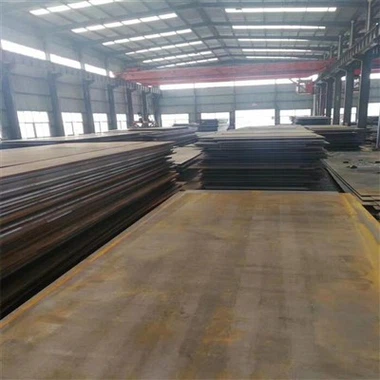
LR AH36 SHIPBUILDING STEEL PLATE
Products Description Taking the standards of Lloyd's Register (LR) classification society as an example, the specific requirements for the processing technology of LR AH36 shipbuilding steel plate may include the following aspects (the actual requirements may vary depending on the...
Description
Products Description
Taking the standards of Lloyd's Register (LR) classification society as an example, the specific requirements for the processing technology of LR AH36 shipbuilding steel plate may include the following aspects (the actual requirements may vary depending on the specifications of different classification societies and specific project needs):
Chemical Composition:
- The content of carbon (C) usually has certain limits to ensure the strength and weldability of the steel.
- The content of manganese (Mn) needs to be within the prescribed range, which helps to improve the strength and toughness of the steel.
- The contents of elements such as silicon (Si), phosphorus (P), and sulfur (S) also need to be controlled at specific levels to ensure the various properties of the steel. For example, the general requirement for phosphorus content is ≤ 0.025%, and for sulfur content is ≤ 0.015%.
Mechanical Properties:
- The yield strength (upper yield strength) ≥ 355 MPa.
- The tensile strength is between 490 - 630 MPa.
- The elongation after fracture ≥ 21%.
- Regarding impact toughness, there are specific requirements for impact absorption energy at different temperatures. For instance, at 0°C, for steel plates with a thickness not exceeding 50mm, the longitudinal and transverse impact absorption energy should be no less than 34J and 24J respectively; when the thickness is 50 - 70mm, the longitudinal and transverse impact absorption energy should be no less than 41J and 27J respectively; when the thickness is 70 - 150mm, the longitudinal and transverse impact absorption energy should be no less than 50J and 34J respectively.
Delivery State: Usually delivered in the normalized state.
Dimensions, Shape, Weight and Allowable Deviations: They need to comply with the provisions of relevant standards (such as GAH36/T709), and the lower deviation of thickness is generally -0.3mm.
Steel Plate Surface Quality:
- The surface should not have harmful defects such as bubbles, scars, cracks, folds, inclusions, and pressed-in scale.
- There should be no visible layering with the naked eye.
Other Requirements:
- According to the requirements of the buyer and through agreement between the supplier and the buyer, non-destructive testing, such as ultrasonic flaw detection, can be conducted. For steel plates with Z-direction performance requirements (such as Z15, Z25, Z35), corresponding Z-direction performance tests are also required.


In actual production, the following points also need to be noted:
1. Strictly control the management of raw materials to ensure that the steel grade, heat number, number of pieces, specifications, and weight of the ship plate billet are consistent with the quality guarantee certificate, the surface quality complies with the regulations, and they are stacked by steel grade, heat number, and specifications as required.
2. Follow the system of delivering steel by heat, conduct full-process heat number tracking, and avoid the occurrence of process accidents due to mixed heat numbers.
3. During the heating process, it is necessary to control the heating rate and the temperature of each section. For example, the heating rate is generally 8 - 10 min/cm, and the maximum heating temperature does not exceed 1300°C.
4. During rolling, attention should be paid to the start rolling temperature, for example, it is usually between 1000 - 1100°C. For the case of controlled-temperature rolling, it is necessary to ensure that the start temperature of finish rolling, the final rolling temperature, and the cooling method after rolling comply with the requirements. For example, for steel plates with a specification of 9 - 14mm, conventional rolling can be adopted, with the start temperature of finish rolling at 900°C, and air cooling or water cooling to 670 - 750°C; for steel plates with a specification of 14 - 36mm, controlled-temperature rolling is adopted, with the start temperature of finish rolling at 950°C, and water cooling to 670 - 750°C.
In conclusion, only by strictly following the specific requirements of the execution standards for processing can the quality and performance of LR AH36 shipbuilding steel plates meet the requirements of ship construction. In specific projects, detailed reference should be made to the relevant classification society specifications and technical documents.
|
|||||||||||||||||||||||||||||||||||||||||||||||||||||||||||||||||||||||||||||||||||||||||||||||||||||||||||||||||||||||||||||||||||||||||||||||||||||||||||||||||||||||||||||||||||||||||||
Hot Tags: lr ah36 shipbuilding steel plate, China lr ah36 shipbuilding steel plate suppliers, factory, Brass, 1 441, C52100, C63000, N08825, CuZn40