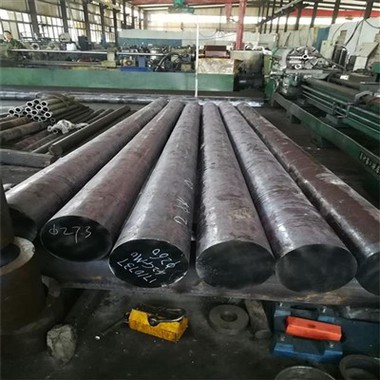
AISI 1050 Steel
Fine Machining of AISI 1050 Steel AISI 1050 steel, a medium carbon steel renowned for its favorable mechanical properties and cost-effectiveness, finds extensive use in diverse applications. When it comes to the fine machining of AISI 1050 steel, several crucial factors demand careful...
Description
Products Description
AISI 1050 Steel Chemical Composition
| Element | Content (%) |
|---|---|
| Iron, Fe | 98.46-98.92 |
| Manganese, Mn | 0.60-0.90 |
| Carbon, C | 0.470-0.55 |
| Sulfur, S | ≤ 0.050 |
| Phosphorous, P | ≤ 0.040 |
AISI 1050 Steel Physical Properties
| Properties | Metric | Imperial |
|---|---|---|
| Density | 7.85 g/cm3 | 0.284 lb/in³ |
AISI 1050 Steel Mechanical Properties
| Properties | Metric | Imperial |
|---|---|---|
| Tensile strength | 690 MPa | 100000 psi |
| Yield strength | 580 MPa | 84100 psi |
| Shear modulus (typical for steel) | 80 GPa | 11600 ksi |
| Bulk modulus (typical for steel) | 140 GPa | 20300 ksi |
| Elastic modulus | 190-210 GPa | 27557-30458 ksi |
| Poisson's ratio | 0.27-0.30 | 0.27-0.30 |
| Elongation at break (in 50 mm) | 10% | 10% |
| Reduction of area | 30% | 30% |
| Hardness, Rockwell C (converted from Brinell hardness. Value below normal HRC range, for comparison purposes only) | 13 | - |
| Hardness, Brinell | 197 | 197 |
| Hardness, Knoop (converted from Brinell hardness) | 219 | 219 |
| Hardness, Rockwell B (converted from Brinell hardness) | 92 | 92 |
| Hardness, Rockwell C (converted from Brinell hardness. Value below normal HRC range, for comparison purposes only) | 13 | 13 |
| Hardness, Vickers (converted from Brinell hardness) | 207 | 207 |
Machining Parameters: Determining the appropriate machining parameters is essential for achieving efficient and accurate machining. Cutting speed, feed rate, and depth of cut need to be meticulously chosen based on the tool material, workpiece material, and machining operation. Generally, lower cutting speeds and higher feed rates are suitable for roughing operations to rapidly remove material, while finer cuts with lower feed rates and higher cutting speeds are employed for finishing operations to obtain a smooth surface finish. Consider a case where AISI 1050 steel shafts are being machined. The parameters are adjusted to ensure precise dimensions and minimal runout.
Cooling and Lubrication: Adequate cooling and lubrication are necessary to reduce heat generation and tool wear during machining. Flood cooling with cutting fluids can effectively dissipate heat and flush away chips, enhancing tool life and surface finish. In some cases, mist cooling or dry machining may be possible, but careful consideration must be given to tool life and surface quality. For example, in a high-volume production environment of AISI 1050 steel components, a continuous flow of cutting fluid is utilized to maintain stable machining conditions and ensure consistent quality.
Workholding: Secure workholding is crucial to guarantee accurate machining and prevent vibration. Clamps, vises, or fixtures should be designed to firmly hold the workpiece without causing deformation or damage. Accessibility of the workpiece for machining operations and ease of loading and unloading should also be considered. In the manufacturing of AISI 1050 steel brackets, custom fixtures are designed to hold the parts securely during machining, ensuring accurate dimensions and tight tolerances.

Surface Finish: Achieving a good surface finish is often a key requirement for fine machining of AISI 1050 steel. This can be accomplished by using appropriate cutting tools, optimizing machining parameters, and employing finishing operations such as grinding or polishing. Surface roughness can be measured using instruments like profilometers to ensure compliance with the required specifications. For instance, in the production of decorative AISI 1050 steel parts, a combination of fine machining and polishing is employed to achieve a mirror-like surface finish.
Quality Control: Implementing a robust quality control system is essential to ensure consistent quality of the machined parts. This may involve inspecting dimensions, surface finish, and mechanical properties using tools such as calipers, micrometers, and hardness testers. Any deviations from the specified requirements should be identified and corrected promptly to prevent further production issues.
In conclusion, fine machining of AISI 1050 steel requires careful consideration of tool selection, machining parameters, cooling and lubrication, workholding, surface finish, and quality control. By paying close attention to these factors, it is possible to achieve high-quality machined parts with tight tolerances and excellent surface finish, meeting the demands of various applications.
Hot Tags: aisi 1050 steel, China aisi 1050 steel suppliers, factory, C34000, 38MnB5, 2 4617, 7071aluminum, SUS440B, HX160YD