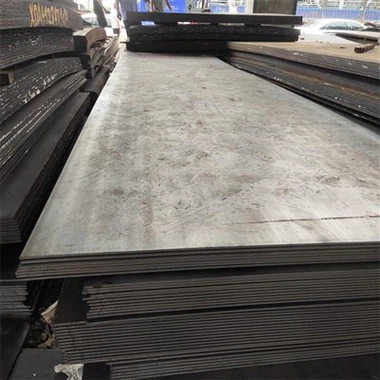
DH Grade Qualified Shipbuilding Plate
Products Description Microalloying elements play an important role in the strength and toughness of shipbuilding steel plates, as follows: I. Effect on strength Grain refinement : Microalloying elements such as niobium (Nb), vanadium (V), and titanium (Ti) can inhibit grain growth during the...
Description
Products Description
Microalloying elements play an important role in the strength and toughness of shipbuilding steel plates, as follows:
I. Effect on strength
Grain refinement:
Microalloying elements such as niobium (Nb), vanadium (V), and titanium (Ti) can inhibit grain growth during the solidification and heat treatment of steel, thereby refining grains. Grain refinement can significantly improve the strength of steel. This is because grain boundaries act as obstacles to dislocation movement. The finer the grains, the larger the grain boundary area and the stronger the obstruction to dislocation movement.
For example, niobium can form carbonitrides in steel. These compounds precipitate at high temperatures and prevent the growth of austenite grains. Vanadium can also form carbonitrides and play a role in inhibiting recrystallization and refining grains during the rolling process of steel.
Precipitation strengthening:
Microalloying elements can form fine carbonitrides or carbide precipitates. These precipitate phases play a role in obstructing dislocation movement in the steel matrix, thereby improving the strength of steel. The effect of precipitation strengthening depends on the size, distribution, and quantity of precipitate phases.
For example, when vanadium carbonitrides precipitate in steel, they can produce significant precipitation strengthening effects. Titanium can also form fine carbonitrides and contribute to the strength improvement of steel to a certain extent.
Solid solution strengthening:
Some microalloying elements can exist in steel in the form of solid solutions. They will distort the crystal lattice of steel and increase the resistance to dislocation movement, thereby improving the strength of steel. For example, manganese (Mn) can play a role in solid solution strengthening to a certain extent.
However, the effect of solid solution strengthening is relatively weak, and excessive solid solution elements may have an adverse effect on the toughness of steel.
II. Effect on toughness
Improving low-temperature toughness:
The addition of microalloying elements can improve the low-temperature toughness of steel by refining grains and optimizing the microstructure. Fine grains can reduce stress concentration at grain boundaries and reduce the initiation and propagation speed of cracks.
For example, microalloying with niobium and vanadium can make shipbuilding steel plates still maintain good toughness at low temperatures and improve the safety of ships in cold sea areas.
Inhibiting the formation of harmful phases:
Some microalloying elements can inhibit the formation of harmful phases in steel, such as reducing the content of pearlite and increasing the toughness of bainite or martensite-austenite (M-A) constituents.
For example, titanium can combine with nitrogen in steel to form stable nitrides and reduce the damage of free nitrogen to the toughness of steel.
Specification we supply:
|
Thickness |
2-200mm |
|
Width |
1000-4000mm |
|
Length |
5000-15000mm |


Improving hydrogen-induced cracking resistance:
In the marine environment, shipbuilding steel plates may be eroded by hydrogen. Some microalloying elements can improve the hydrogen-induced cracking resistance of steel, thereby improving the toughness and service life of steel.
For example, vanadium can form stable carbonitrides, reduce the diffusion and aggregation of hydrogen in steel, and reduce the risk of hydrogen-induced cracking.
Why Choose Us?
We take pride in our ability to provide custom solutions for our customers' unique needs.
We analyze and compare the previous products and the current technical situation of our DH Grade Qualified Shipbuilding Plate, and develop new technical specifications and processes.
Our customers trust us to deliver high-quality Cold-rolled Steel products on time and on budget.
We strictly implement the warm and thoughtful after-sales service, adhere to the development of good professional ethics.
We offer a wide range of Cold-rolled Steel products to meet diverse customer needs.
We adhere to the customer-centric and brand-oriented business philosophy, and continue to provide customers with reliable and excellent products and services.
Our factory is committed to upholding the highest standards of safety and quality.
All staff of our company and all departments work together to combine business management, professional technology, quantitative statistical methods and ideological education.
Our Cold-rolled Steel products are known for their durability and reliability.
Relying on the superior conditions and strong advantages of mass production, we are able to meet the different needs of our customers.
Hot Tags: dh grade qualified shipbuilding plate, China dh grade qualified shipbuilding plate suppliers, factory, CuSn8, 30NiCrMo16-6, 403 Stainless Steel, C11000, CR2 Steel, S620QL1