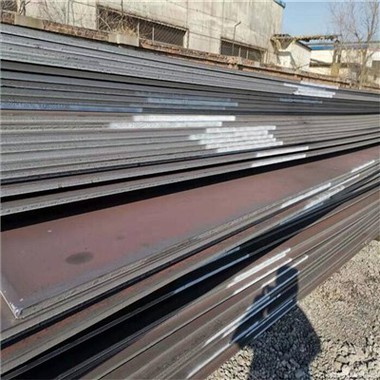
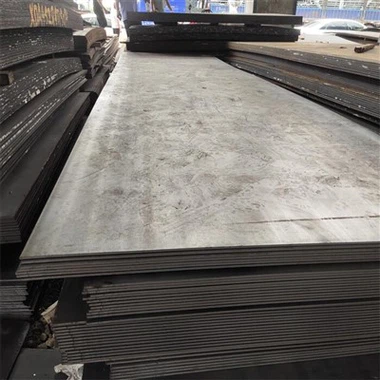
GL-F32 Steel Plate
Products Description Handling of Welding Defects (A) Handling of Appearance Defects Undercut Handling Method : For shallower undercuts (with a depth not exceeding the specified allowable value), the sharp edges of the undercut can be smoothed by grinding to make a smooth transition with the...
Description
Products Description
Handling of Welding Defects
(A) Handling of Appearance Defects
Undercut
Handling Method: For shallower undercuts (with a depth not exceeding the specified allowable value), the sharp edges of the undercut can be smoothed by grinding to make a smooth transition with the surface of the base metal. If the undercut depth exceeds the allowable value, in addition to grinding, repair welding is required. When performing repair welding, appropriate welding process parameters should be used to ensure the quality of the repair welding.
Porosity
Handling Method: For surface pores, first, the oxide scale, oil stains, and other impurities around the pores should be cleaned thoroughly, and then repair welding should be carried out. When performing repair welding, attention should be paid to controlling the welding environment and welding process parameters to avoid the recurrence of pores. For pores hidden inside the weld, if their positions and sizes are determined by non-destructive testing and these pores have a significant impact on the quality of the weld, rework is also required. Generally, the part of the weld containing the pores is removed and then rewelded.
Slag Inclusion
Handling Method: For surface slag inclusions, first, use tools such as flat chisels and wire brushes to clean the slag inclusions thoroughly, and then perform repair welding on the cleaned area. During the repair welding process, attention should be paid to adjusting the welding process parameters to ensure that the slag can float out of the molten pool smoothly. For slag inclusions in multi-pass and multi-layer welding, it is also necessary to check whether there are slag inclusions in the adjacent layers. If so, they should be cleaned and repaired together.


Lack of Fusion
Handling Method: For the lack-of-fusion defect, first, the lack-of-fusion area and its surrounding oxide layers and impurities should be cleaned thoroughly, and then repair welding should be carried out using an appropriate welding process. When performing repair welding, the welding parameters should be adjusted appropriately, such as increasing the welding current and reducing the welding speed, to ensure that the weld metal and the base metal can be fully melted and combined. At the same time, after the repair welding, the repaired area should be inspected to ensure that the defect has been completely eliminated.
(B) Handling of Internal Defects
Crack
Handling Method: Cracks are a serious type of welding defect and must be completely removed once detected. For surface cracks, mechanical methods (such as grinding and carbon arc gouging) can be used to remove the cracks, and then the area after crack removal should be preheated (the preheating temperature is determined according to the material and the thickness of the welded part), and then repair welding should be carried out using an appropriate welding process. After repair welding, appropriate post-heat treatment should be carried out to eliminate welding stress. For internal cracks, after determining their positions and ranges by non-destructive testing, generally, the method of patching is adopted, that is, the part of the weld containing the cracks is removed and then rewelded, and corresponding heat treatment and quality inspection are carried out.
Incomplete Penetration
Handling : For the incomplete penetration defect, if the length and depth of the incomplete penetration are relatively small and have little impact on the quality of the weld, the surface of the weld can be smoothed by grinding, and then strengthening welding can be carried out. If the incomplete penetration is relatively serious and affects the strength and sealing properties of the weld, etc., the part of the incomplete penetration and its surrounding weld should be removed and then rewelded. When rewelding, the welding process parameters should be adjusted, such as increasing the welding current and adjusting the groove angle, to ensure that the root can be completely penetrated.
Why Choose Us?
We take pride in our ability to provide custom solutions for our customers' unique needs.
We analyze and compare the previous products and the current technical situation of our GL-F32 Steel Plate, and develop new technical specifications and processes.
Our customers trust us to deliver high-quality Cold-rolled Steel products on time and on budget.
We strictly implement the warm and thoughtful after-sales service, adhere to the development of good professional ethics.
We offer a wide range of Cold-rolled Steel products to meet diverse customer needs.
We adhere to the customer-centric and brand-oriented business philosophy, and continue to provide customers with reliable and excellent products and services.
Our factory is committed to upholding the highest standards of safety and quality.
All staff of our company and all departments work together to combine business management, professional technology, quantitative statistical methods and ideological education.
Our Cold-rolled Steel products are known for their durability and reliability.
Relying on the superior conditions and strong advantages of mass production, we are able to meet the different needs of our customers.
Hot Tags: gl-f32 steel plate, China gl-f32 steel plate suppliers, factory, 430 Stainless Steel, HC380LA, C68800, HX300BD, SUS309S, S410000