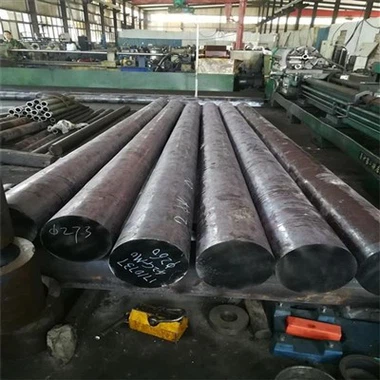
34CrAlMo5 Steel
34CrAlMo5 Steel is a remarkable alloy steel that offers a combination of unique properties and finds extensive use in multiple industries. **Chemical Composition**: - Chromium (Cr): Present in the range of 1.20% to 1.60%. This element contributes to the steel's hardness, corrosion...
Description
34CrAlMo5 Steel: A Comprehensive Overview
34CrAlMo5 steel is a specialized alloy steel known for its exceptional properties and wide-ranging applications across different industries.
Chemical Composition Insights:
Chromium (Cr): With a content ranging from 1.20% to 1.60%, chromium imparts hardness, corrosion resistance, and heat resistance to the steel. It forms a protective oxide layer on the surface, enhancing the steel's durability in harsh environments.
Aluminum (Al): Present in an approximate range of 0.80% to 1.20%, aluminum plays a crucial role in strengthening the steel and improving its oxidation resistance. It helps in the formation of a stable oxide layer, which protects the steel from high-temperature oxidation.
Molybdenum (Mo): Occurring in the range of 0.15% to 0.25%, molybdenum enhances the steel's strength at elevated temperatures and also contributes to its toughness. It helps in preventing softening and creep at high temperatures.
Carbon (C): Having a content of 0.30% to 0.38%, carbon is a fundamental element that determines the hardness and strength of the steel. It forms carbides, which contribute to the steel's wear resistance and strength.
Silicon (Si): Typically in the range of 0.15% to 0.35%, silicon improves the fluidity of the steel during casting and also enhances its electrical conductivity. It helps in deoxidizing the steel and improving its overall quality.
Manganese (Mn): Ranging from 0.40% to 0.70%, manganese aids in deoxidizing the steel and improving its hardenability. It also helps in reducing the brittleness of the steel and improving its ductility.
Mechanical Properties at a Glance:
| Property | Details |
|---|---|
| Tensile Strength | Generally falls between 980 MPa and 1180 MPa. This high tensile strength enables the steel to withstand heavy loads and stresses, making it suitable for applications in demanding environments. |
| Yield Strength | Around 835 MPa to 930 MPa. The yield strength indicates the stress at which the steel begins to deform plastically, providing an important measure of the steel's strength and durability. |
| Elongation | Approximately 12% to 14%. Elongation measures the ability of the steel to stretch before breaking, indicating its ductility and flexibility. A higher elongation percentage indicates greater ductility. |
| Impact Toughness | Can have an impact energy value of [specific value, e.g., 50 J at room temperature]. Impact toughness reflects the steel's ability to resist sudden impacts and shocks, making it important for applications where the steel may be subjected to dynamic loading. |
Heat Treatment Processes Unraveled:
Annealing: This process involves heating the steel to a temperature of about 800°C to 850°C and then slowly cooling it. Annealing helps in relieving internal stresses, softening the steel, and improving its machinability. It also refines the grain structure, making the steel more homogeneous and easier to work with.
Normalizing: The steel is heated to a temperature around 880°C to 920°C and then air-cooled. Normalizing refines the grain structure further, increases the uniformity of the microstructure, and improves the steel's mechanical properties. It also helps in reducing residual stresses and improving the dimensional stability of the steel.
Quenching: Typically, the steel is heated to a temperature of about 850°C to 880°C and then rapidly cooled in a suitable quenching medium, such as oil. Quenching hardens the steel by transforming its microstructure, increasing its hardness and strength. However, quenched steel can be brittle, so it often requires further heat treatment.
Tempering: After quenching, the steel is reheated to a lower temperature, usually in the range of 550°C to 650°C, and held at that temperature for a specific period. Tempering reduces brittleness and improves toughness while maintaining a good balance of strength. It also helps in relieving internal stresses and improving the dimensional stability of the steel.
Applications Across Industries:
Aerospace Industry: In the aerospace sector, 34CrAlMo5 steel is used for manufacturing critical components such as turbine blades, engine parts, and structural elements. The steel's high strength, heat resistance, and corrosion resistance make it ideal for withstanding the extreme conditions encountered in aerospace applications.
Automotive Industry: In the automotive industry, it is employed for making engine components like crankshafts, connecting rods, and gears. The steel's durability and mechanical properties ensure the reliable operation of the vehicle even under high-stress conditions.
Oil and Gas Industry: In the oil and gas industry, 34CrAlMo5 steel is used in the production of drilling tools, valves, and pipelines. Its resistance to corrosion and high strength make it suitable for harsh operating environments, where it must withstand high pressures and corrosive substances.
Mechanical Engineering: In mechanical engineering, it is utilized for producing shafts, bearings, and gears. The steel's excellent mechanical properties and wear resistance make it a preferred choice for applications where reliability and durability are essential.
In conclusion, 34CrAlMo5 steel is a remarkable alloy steel with a unique combination of chemical composition and mechanical properties. Through proper heat treatment and application in different industries, it plays a crucial role in ensuring the performance and reliability of various components and systems.
Hot Tags: 34cralmo5 steel, China 34cralmo5 steel suppliers, factory, 1 455, 440A, 1 4539, E250C N, C63010, CR240LA