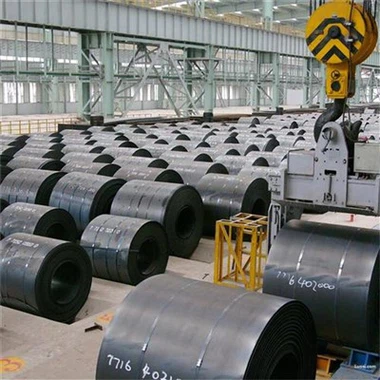
Manufacture CCS/ABS/BV High-Strength Carbon Ship/Bridge Hot Rolled Steel Plate
Products Description Factor of Oil Product Density When an oil tanker transports high - density oil products (such as heavy crude oil), due to the high density of the oil products, the mass of the oil products is greater for the same tank volume. According to the liquid static pressure formula...
Description
Products Description
Factor of Oil Product Density
When an oil tanker transports high - density oil products (such as heavy crude oil), due to the high density of the oil products, the mass of the oil products is greater for the same tank volume. According to the liquid static pressure formula (where is the liquid static pressure, is the liquid density, is the gravitational acceleration, and is the liquid depth), the static pressure on the tank wall is greater. To resist this greater pressure and prevent the tank wall from deforming or rupturing, thicker steel plates are required. For example, the density of heavy crude oil may reach about 0.9 - 0.95g/cm³. For a large - sized oil tank, the tank wall may require steel plates with a thickness of 30 - 50mm.
Conversely, when transporting light - density oil products (such as gasoline and light diesel), their density is generally around 0.7 - 0.78g/cm³. Under the same tank size, the generated static pressure is relatively small, and the pressure on the tank wall is also smaller. Therefore, for an oil tanker transporting light - density oil products, the thickness of the steel plates of the tank wall can be relatively thin, probably around 10 - 20mm.
Factor of Tank Size
The height and volume of the oil tank also have an important impact on the thickness of the steel plates. For a tall and large oil tank, even when transporting oil products with the same density, due to the greater liquid depth, according to the static pressure formula, the static pressure on the bottom of the tank wall will be greater. For example, the height of an oil tank of a very - large - crude - carrier (VLCC) may reach 20 - 30 meters. When transporting heavy crude oil, the bottom of the tank wall requires thick enough steel plates (such as 30 - 50mm) to bear the huge pressure.
For a small - sized oil tanker or a case where the oil tank size is small, even when transporting high - density oil products, because the liquid depth is relatively small, the pressure on the tank wall is also relatively small. So the thickness of the steel plates can be appropriately reduced. For example, the thickness of the tank walls of some small - sized oil tankers may be around 15 - 25mm.
| Thickness | 2-300mm (2-100mm usually used) |
| Width | 1000-3000mm (1000-2200mm usually used) |
| Length | 1000-12000mm or as your request |


Factor of Transportation Conditions and Safety Factor
If an oil tanker often sails in severe sea conditions, such as on the rough high seas or in a sea area with changeable climate, the oil products in the tank will generate greater sloshing impact force due to the shaking of the ship. To ensure the safety of the tank wall under such complex working conditions, even when transporting light - density oil products, the thickness of the steel plates may be appropriately increased to improve the safety factor. For example, for an oil tanker that often sails in the North Atlantic, compared with the same type of oil tanker that sails in a relatively calm sea area, the thickness of the steel plates of its tank wall may be increased by about 5 - 10mm.
In addition, for an oil tanker transporting high - risk oil products (such as chemicals, liquefied natural gas, etc.), to prevent accidents such as leakage, a higher safety factor is required. In this case, the thickness of the steel plates of the tank wall should not only consider the static pressure and sloshing impact force, but also factors such as the corrosiveness of the oil products. Special anti - corrosion steel plates may be used and the thickness may be increased to ensure transportation safety.
Why Choose Us?
We take pride in our ability to provide custom solutions for our customers' unique needs.
We analyze and compare the previous products and the current technical situation of our Manufacture CCS/ABS/BV High-Strength Carbon Ship/Bridge Hot Rolled Steel Plate, and develop new technical specifications and processes.
Our customers trust us to deliver high-quality Cold-rolled Steel products on time and on budget.
We strictly implement the warm and thoughtful after-sales service, adhere to the development of good professional ethics.
We offer a wide range of Cold-rolled Steel products to meet diverse customer needs.
We adhere to the customer-centric and brand-oriented business philosophy, and continue to provide customers with reliable and excellent products and services.
Our factory is committed to upholding the highest standards of safety and quality.
All staff of our company and all departments work together to combine business management, professional technology, quantitative statistical methods and ideological education.
Our Cold-rolled Steel products are known for their durability and reliability.
Relying on the superior conditions and strong advantages of mass production, we are able to meet the different needs of our customers.
Hot Tags: manufacture ccs/abs/bv high-strength carbon ship/bridge hot rolled steel plate, China manufacture ccs/abs/bv high-strength carbon ship/bridge hot rolled steel plate suppliers, factory, 304 Stainless Steel, C38500, C276, CuAl9Mn2, SUS304L, SK7 Steel