

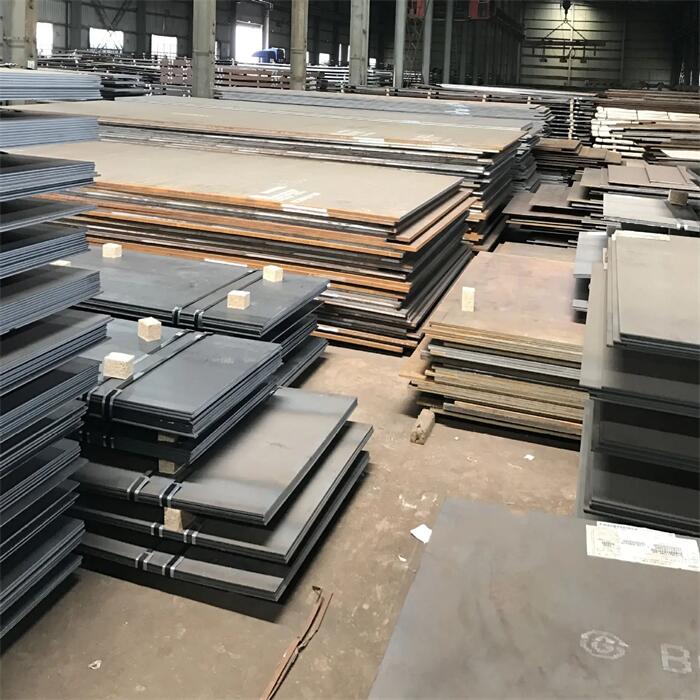


KR E32 Steel Plate
Products Description In Terms of Inhibiting Anodic Dissolution Reaction In electrolyte solutions (such as seawater and acidic solutions), the chromium oxide layer on the metal surface can inhibit the anodic dissolution reaction of the metal. This is because the chromium oxide layer has a certain...
Description
Products Description
In Terms of Inhibiting Anodic Dissolution Reaction
In electrolyte solutions (such as seawater and acidic solutions), the chromium oxide layer on the metal surface can inhibit the anodic dissolution reaction of the metal. This is because the chromium oxide layer has a certain degree of electron conductivity, which will change the electron transfer process on the metal surface. Under normal circumstances, the loss of electrons (oxidation) by metal atoms, leading to anodic dissolution, is a crucial step in the corrosion process. However, the presence of the chromium oxide layer makes it difficult for metal atoms to lose electrons, just like putting a "electronic protective suit" on the metal, reducing the activity of the metal as an anode. For example, in seawater containing chloride ions, ordinary metals are prone to anodic dissolution and corrosion. But if there is a chromium oxide layer on the metal surface, this corrosion process will be significantly inhibited.
From an electrochemical perspective, the chromium oxide layer changes the interface properties between the metal and the electrolyte solution. When there is no chromium oxide layer, the metal is in direct contact with the electrolyte, and the electrons on the metal surface can freely exchange with the ions in the solution, resulting in the easy occurrence of anodic reactions. However, after the formation of the chromium oxide layer, electrons need to overcome the obstruction of the chromium oxide layer to transfer, which increases the energy barrier of the anodic reaction and significantly reduces the rate of anodic dissolution reaction.
In Terms of Changing the Corrosion Potential
The chromium oxide layer on the metal surface will shift the corrosion potential of the metal in the positive direction, that is, changing the metal towards a more corrosion-resistant direction. The corrosion potential is an important indicator for measuring the corrosion tendency of a metal in an electrolyte solution. After the formation of the chromium oxide layer on the metal surface, it changes the chemical state and charge distribution on the metal surface, making the metal less likely to become an anode and be corroded in an electrochemical corrosion cell. For example, in some acidic solutions containing corrosive ions, the corrosion potential of the metal protected by the chromium oxide layer is more positive than that of the unprotected metal, which means that its corrosion tendency is lower and it can remain relatively stable in a more severe electrolyte environment.
This change in corrosion potential is also related to the thickness and integrity of the chromium oxide layer. Generally speaking, a thicker and intact chromium oxide layer can change the corrosion potential more effectively, endowing the metal with better corrosion resistance. Because a thick chromium oxide layer can provide a stronger electron obstruction effect, further reducing the activity of the metal as an anode, and at the same time, it can better isolate the metal from the electrolyte solution, reducing the occurrence of corrosion reactions.
In Terms of Blocking the Penetration of Corrosive Ions
The chromium oxide layer has a dense structure and can effectively block the penetration of corrosive ions (such as chloride ions, sulfate ions, etc.). In electrolyte solutions, these corrosive ions are one of the main factors causing metal corrosion. They will penetrate through the protective layer on the metal surface and react chemically with metal atoms, thereby causing corrosion. The chromium oxide layer is like a solid "city wall". Due to its compact structure, it is very difficult for corrosive ions to penetrate. For example, in the marine environment, chloride ions are highly corrosive. But if there is a good chromium oxide layer on the metal surface, chloride ions are very difficult to break through this protective layer, thus significantly reducing the risk of metal corrosion.
Even if the chromium oxide layer develops tiny pores or damages under the long-term immersion in electrolyte solutions or mechanical actions, it still has a certain blocking effect. This is because the chemical stability of chromium oxide enables it to repair itself to a certain extent or slow down the penetration speed of corrosive ions. As long as the damage is not too severe, the chromium oxide layer can still play its blocking function and provide protection for the metal.
|
KR/R E32 high Strength Chemical Composition |
|||||||
|
Grade |
The Element Max (%) |
||||||
|
C |
Si |
Mn |
P |
S |
Al |
N |
|
|
KR/R E32 |
0.18 |
0.50 |
0.90-1.6 |
0.035 |
0.035 |
0.015 |
- |
|
Nb |
V |
Ti |
Cu |
Cr |
Ni |
Mo |
|
|
0.02-0.05 |
0.05-0.10 |
0.09-1.60 |
0.35 |
0.2 |
0.4 |
0.08 |
|


Improving the Corrosion Resistance of the Microstructure of Alloys
Enhancing the Corrosion Resistance of Grain Boundaries: In alloys, the oxygen - affinity of chromium can have a positive impact on the grain boundaries. Due to the reaction between chromium and oxygen, some chromium oxides may be formed at the grain boundaries. These oxides can fill the tiny pores at the grain boundaries and reduce the accumulation of impurity elements at the grain boundaries. During the corrosion process, the grain boundaries are often the areas where corrosion is likely to occur because impurities and grain boundary defects will form local electrochemically active areas. The presence of chromium oxides at the grain boundaries can effectively prevent corrosive media from permeating along the grain boundaries, thereby improving the corrosion resistance of the alloy at the microstructure level.
Promoting the Uniform Distribution of Alloy Elements: The oxygen - affinity of chromium also helps to evenly distribute alloy elements within the alloy. During the solidification process of the alloy, the reaction between chromium atoms and oxygen may change the diffusion behavior of alloy elements. For example, some elements that are prone to segregation may be more evenly distributed in the alloy matrix due to the presence of chromium. This uniform distribution can reduce local corrosion phenomena such as pitting and intergranular corrosion caused by the local enrichment of elements. Because when alloy elements are evenly distributed, the electrochemical properties on the entire alloy surface are more uniform, and it is not easy to form local corrosion cells.
Why Choose Us?
We take pride in our ability to provide custom solutions for our customers' unique needs.
We analyze and compare the previous products and the current technical situation of our KR E32 Steel Plate, and develop new technical specifications and processes.
Our customers trust us to deliver high-quality Cold-rolled Steel products on time and on budget.
We strictly implement the warm and thoughtful after-sales service, adhere to the development of good professional ethics.
We offer a wide range of Cold-rolled Steel products to meet diverse customer needs.
We adhere to the customer-centric and brand-oriented business philosophy, and continue to provide customers with reliable and excellent products and services.
Our factory is committed to upholding the highest standards of safety and quality.
All staff of our company and all departments work together to combine business management, professional technology, quantitative statistical methods and ideological education.
Our Cold-rolled Steel products are known for their durability and reliability.
Relying on the superior conditions and strong advantages of mass production, we are able to meet the different needs of our customers.
Hot Tags: kr e32 steel plate, China kr e32 steel plate suppliers, factory, 500HB Steel, C276, C34200, 1 4438, N10276, 2 4851


